Holland Park: From Aristocratic Estate to Urban Sanctuary
Holland Park stands as one of Kensington's most cherished green spaces, its 22.5 hectares bearing witness to four centuries of English history, from Jacobean splendour to wartime destruction and civic renewal.
The Rise of a Jacobean Mansion
Construction of what would become Holland House began in 1605, commissioned by Sir Walter Cope. The estate's name derived not from its builder but from a later owner; the house passed by marriage to Henry Rich, who became the 1st Earl of Holland, and the building assumed his title.
The mansion entered its most celebrated period in the mid-18th century when Henry Fox, later created Baron Holland, leased and subsequently purchased the estate. Under the Fox family, Holland House became a noted centre of Whig political and social life, drawing statesmen, writers, and thinkers to its salons and gardens.
By 1874, ownership had passed to Henry Fox-Strangways, 5th Earl of Ilchester, a distant relative of the Fox line. The house remained in aristocratic hands until the upheavals of the 20th century would transform its purpose entirely.
The Blitz and Its Aftermath
The night of 27 September 1940 brought devastation. During a ten-hour German air raid on London, twenty-two incendiary bombs struck Holland House. The Jacobean mansion, already weakened by dry rot in its west wing, burned fiercely. When the flames subsided, only the east wing and much of the library had survived.
The ruins stood as a poignant reminder of war's destruction, yet they also presented an opportunity. Rather than clear the site entirely, the remaining structures would eventually find new purpose as the backdrop to public life.
From Private Estate to Public Park
In 1952, the London County Council acquired Holland House and fifty-two acres of surrounding grounds from the 6th Earl of Ilchester for £250,000. The purchase marked a decisive shift from private aristocratic holding to public asset.
The council's vision transformed the wounded estate into a municipal park. The surviving east wing found practical use; it housed a youth hostel for a period and now accommodates the Belvedere restaurant and other facilities. The ruined walls of the original house were stabilised and retained, creating a distinctive architectural feature that distinguishes Holland Park from London's other green spaces.
The Park Today
Contemporary Holland Park spans approximately 22.5 hectares, bordered by Kensington High Street to the south, Holland Park Avenue to the north, and Kensington Palace Gardens to the east. Abbotsbury Road marks its western edge.
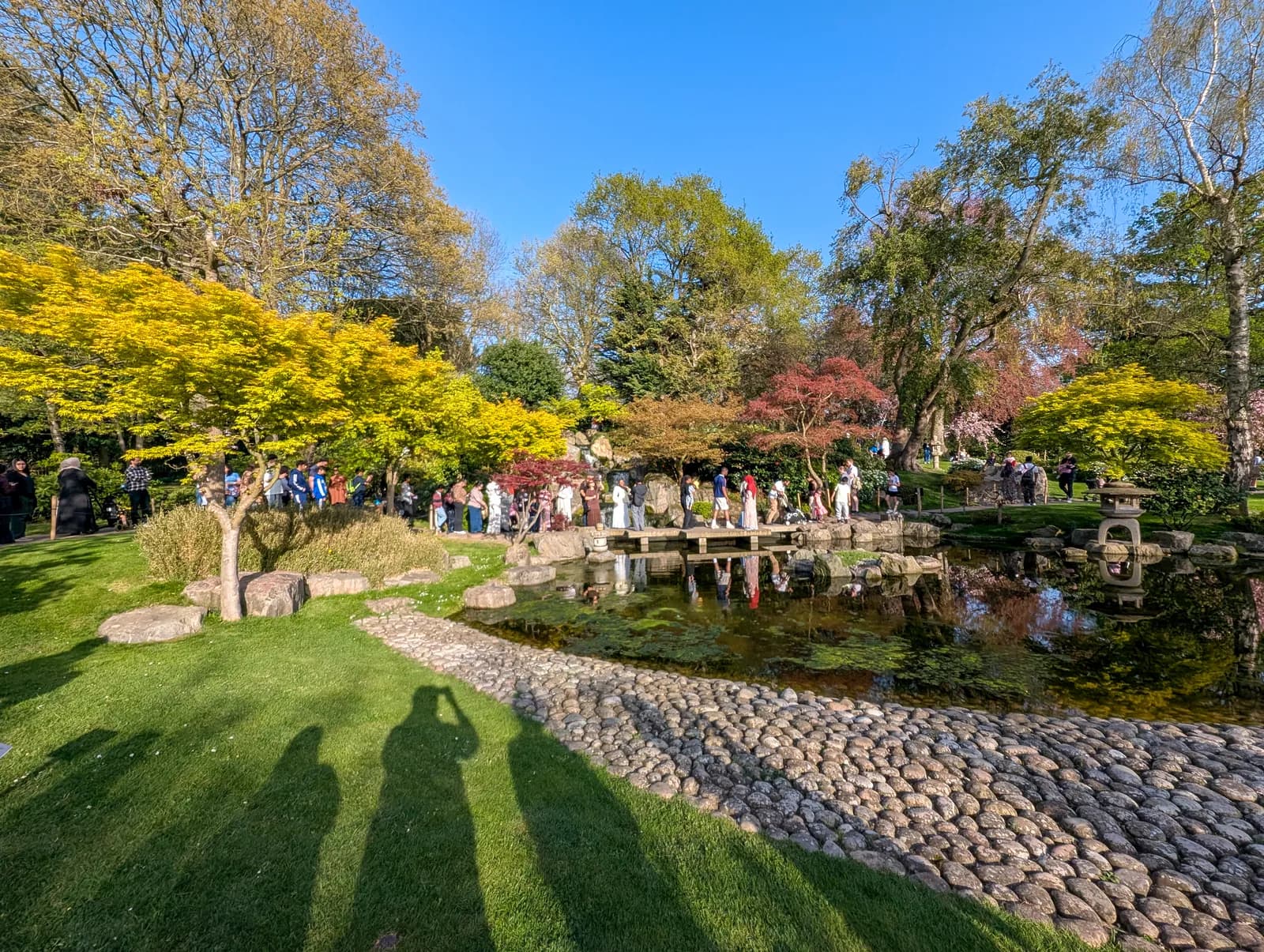
The park's development as a public amenity has seen the addition of features that complement its historical character. The Kyoto Garden, opened in 1991, brings Japanese landscaping to the former estate grounds; its tiered waterfalls and maple plantings offer a contemplative counterpoint to the surrounding urban density. The Fukushima Memorial Garden followed in 2012, commemorating the Japanese earthquake and tsunami.
Contemporary facilities include tennis courts, a cricket pitch, a children's playground, and a giant chess set. The park maintains a population of peacocks and squirrels, descendants of long-established colonies. A café provides refreshment near the Holland House ruins.
Local Significance
For Kensington residents, Holland Park represents both historical continuity and everyday utility. The park's grounds host summer opera performances, using the atmospheric backdrop of the ruined house for open-air theatre. School groups explore its woodland and formal gardens. Commuters cut through its paths between Kensington High Street and Notting Hill.
The Royal Borough of Kensington and Chelsea now manages the park, balancing conservation of its heritage features with the demands of modern urban recreation. The surviving Jacobean fragments remind visitors of the estate's aristocratic origins, even as the space functions as democratic public realm.
Holland Park thus embodies a particular London narrative; private wealth transformed through war and civic initiative into shared inheritance. The ruined walls that survived the Blitz now shelter picnickers and performers rather than politicians, yet they retain the power to evoke the centuries of history that shaped this corner of Kensington.